When You Kick Against the World You Kick Agains a Shappend Awl
/https://tf-cmsv2-smithsonianmag-media.s3.amazonaws.com/filer/Little-Bighorn-flats-631.jpg)
Editor's notation: In 1874, an Regular army expedition led by Lt. Col. George Armstrong Custer plant gold in the Blackness Hills, in nowadays-day South Dakota. At the time, the United States recognized the hills as property of the Sioux Nation, under a treaty the 2 parties had signed vi years earlier. The Grant administration tried to buy the hills, only the Sioux, because them sacred ground, refused to sell; in 1876, federal troops were dispatched to force the Sioux onto reservations and pacify the Dandy Plains. That June, Custer attacked an encampment of Sioux, Cheyenne and Arapaho on the Little Bighorn River, in what is now Montana.
The Battle of the Little Bighorn is one of the virtually studied actions in U.Southward. military machine history, and the immense literature on the subject is devoted primarily to answering questions about Custer's generalship during the fighting. But neither he nor the 209 men in his immediate command survived the day, and an Indian counterattack would pin down 7 companies of their fellow 7th Cavalrymen on a hilltop over four miles away. (Of about 400 soldiers on the hilltop, 53 were killed and 60 were wounded earlier the Indians ended their siege the adjacent day.) The experience of Custer and his men tin be reconstructed only by inference.
This is not true of the Indian version of the boxing. Long-neglected accounts given by more than than 50 Indian participants or witnesses provide a ways of tracking the fight from the first warning to the killing of the last of Custer's troopers—a period of about two hours and xv minutes. In his new book, The Killing of Crazy Horse, veteran reporter Thomas Powers draws on these accounts to present a comprehensive narrative business relationship of the boxing as the Indians experienced it. Crazy Horse'due south stunning victory over Custer, which both angered and frightened the Army, led to the killing of the chief a twelvemonth later. "My purpose in telling the story equally I did," Powers says, "was to let the Indians draw what happened, and to place the moment when Custer's men disintegrated every bit a fighting unit and their defeat became inevitable."
The sun was just cracking over the horizon that Sunday, June 25, 1876, every bit men and boys began taking the horses out to graze. Commencement calorie-free was also the time for the women to poke up final dark'southward cooking fire. The Hunkpapa woman known as Good White Buffalo Adult female said afterward she had often been in camps when war was in the air, but this twenty-four hour period was not like that. "The Sioux that morning time had no thought of fighting," she said. "We expected no attack."
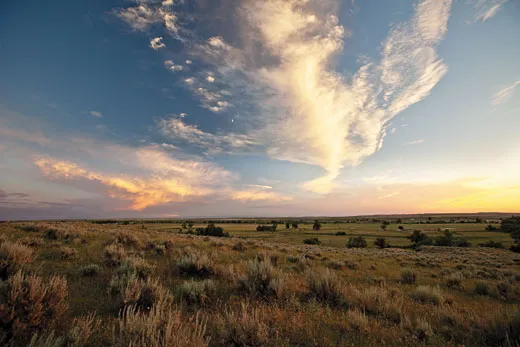
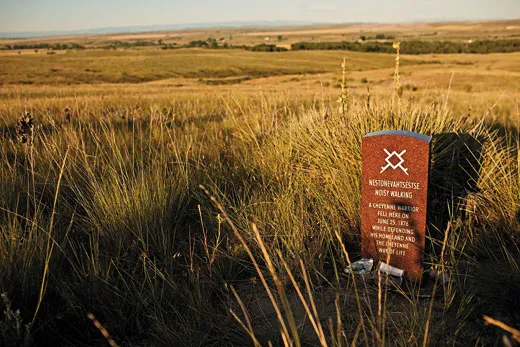
Those who saw the assembled encampment said they had never seen one larger. It had come up together in March or Apr, even before the plains started to greenish up, according to the Oglala warrior He Dog. Indians arriving from afar reservations on the Missouri River had reported that soldiers were coming out to fight, and then the various camps made a betoken of keeping close together. There were at least six, perhaps vii, cheek by jowl, with the Cheyennes at the northern, or downriver, finish near the broad ford where Medicine Tail Coulee and Muskrat Creek emptied into the Little Bighorn River. Among the Sioux, the Hunkpapas were at the southern terminate. Betwixt them forth the river's bends and loops were the Sans Arc, Brulé, Minneconjou, Santee and Oglala. Some said the Oglala were the biggest group, the Hunkpapa next, with maybe 700 lodges between them. The other circles might have totaled 500 to 600 lodges. That would suggest as many as 6,000 to seven,000 people in all, a third of them men or boys of fighting historic period. Confusing the question of numbers was the constant arrival and departure of people from the reservations. Those travelers—plus hunters from the camps, women out gathering roots and herbs and seekers of lost horses—were part of an informal early-warning system.
At that place were many late risers this forenoon because dances the previous night had ended only at beginning lite. One very big tent near the center of the hamlet—probably two lodges raised side by side—was filled with the elders, called chiefs by the whites merely "short hairs," "silent eaters" or "big bellies" by the Indians. Equally the morning turned hot and sultry, large numbers of adults and children went swimming in the river. The h2o would have been cold; Black Elk, the future Oglala holy man, then 12, would remember that the river was high with snowmelt from the mountains.
It was budgeted midafternoon when a report arrived that U.S. troops had been spotted approaching the camp. "Nosotros could hardly believe that soldiers were so about," the Oglala elder Runs the Enemy said afterward. It made no sense to him or the other men in the big lodge. For one affair, whites never attacked in the middle of the day. For several moments more, Runs the Enemy recalled, "We sabbatum at that place smoking."
Other reports followed. White Bull, a Minneconjou, was watching over horses most camp when scouts rode down from Ash Creek with news that soldiers had shot and killed an Indian boy at the fork of the creek two or three miles back. Women who had been digging turnips across the river some miles to the east "came riding in all out of breath and reported that soldiers were coming," said the Oglala chief Thunder Conduct. "The country, they said, looked as if filled with smoke, so much grit was there." The soldiers had shot and killed ane of the women. Fast Horn, an Oglala, came in to say he had been shot at by soldiers he saw near the loftier dissever on the way over into the Rosebud valley.
Just the offset warning to bring warriors on the run probably occurred at the Hunkpapa camp around 3 o'clock, when some horse raiders—Arikara (or Ree) Indians working for the soldiers, equally it turned out—were seen making a dash for animals grazing in a ravine non far from the camp. Within moments shooting could be heard at the south cease of army camp. Peace quickly gave fashion to pandemonium—shouts and cries of women and children, men calling for horses or guns, boys sent to find mothers or sisters, swimmers rushing from the river, men trying to organize resistance, looking to their weapons, painting themselves or tying up their horses' tails.
As warriors rushed out to confront the equus caballus thieves, people at the southernmost terminate of the Hunkpapa camp were shouting alarm at the sight of approaching soldiers, beginning glimpsed in a line on horseback a mile or two abroad. By 10 or xv minutes past 3 o'clock, Indians had boiled out of the lodges to meet them. At present came the commencement shots heard back at the council lodge, convincing Runs the Enemy to put his pipe aside at final. "Bullets sounded like hail on tepees and tree tops," said Little Soldier, a Hunkpapa warrior. The family of master Gall—2 wives and their three children—were shot to death virtually their lodge at the border of the camp.
But at present the Indians were rushing out and shooting back, making show enough to cheque the attack. The whites dismounted. Every fourth human took the reins of 3 other horses and led them along with his ain into the trees near the river. The other soldiers deployed in a skirmish line of perhaps 100 men. Information technology was all happening very speedily.
As the Indians came out to run into the skirmish line, straight ahead, the river was to their left, obscured by thick timber and undergrowth. To the right was open prairie rise abroad to the west, and across the end of the line, a force of mounted Indians quickly accumulated. These warriors were swinging wide, swooping effectually the end of the line. Some of the Indians, He Dog and Dauntless Eye among them, rode out still farther, circling a pocket-sized hill backside the soldiers.
Past then the soldiers had begun to bend back around to face the Indians behind them. In effect the line had halted; firing was heavy and rapid, but the Indians racing their ponies were difficult to hitting. E'er-growing numbers of men were rushing out to meet the soldiers while women and children fled. No more than 15 or 20 minutes into the fight the Indians were gaining command of the field; the soldiers were pulling dorsum into the trees that lined the river.
The pattern of the Boxing of the Picayune Bighorn was already established—moments of intense fighting, rapid motion, close engagement with men falling expressionless or wounded, followed by sudden relative quiet as the 2 sides organized, took stock and prepared for the next clash. Every bit the soldiers disappeared into the copse, Indians by ones and twos cautiously went in after them while others gathered nearby. Shooting fell away merely never halted.
Two large movements were unfolding simultaneously—near of the women and children were moving north down the river, leaving the Hunkpapa army camp behind, while a growing stream of men passed them on the manner to the fighting—"where the excitement was going on," said Eagle Elk, a friend of Ruby-red Feather, Crazy Equus caballus'south brother-in-police. Crazy Horse himself, already renowned amongst the Oglala for his battle prowess, was approaching the scene of the fighting at about the same time.
Crazy Horse had been swimming in the river with his friend Yellow Nose when they heard shots. Moments later on, horseless, he met Red Feather bridling his pony. "Accept any horse," said Red Feather equally he prepared to nuance off, but Crazy Equus caballus waited for his own mountain. Red Feather didn't see him once more until 10 or xv minutes later, when the Indians had gathered in forcefulness almost the wood where the soldiers had taken refuge.
It was probably during those minutes that Crazy Horse had prepared himself for war. In the emergency of the moment many men grabbed their weapons and ran toward the shooting, but non all. State of war was also dangerous to treat casually; a human being wanted to be properly dressed and painted before charging the enemy. Without his medicine and time for a prayer or vocal, he would exist weak. A 17-year-onetime Oglala named Standing Conduct reported that after the beginning warnings Crazy Horse had called on a wicasa wakan (medicine homo) to invoke the spirits and then took so much time over his preparations "that many of his warriors became impatient."
10 young men who had sworn to follow Crazy Horse "anywhere in battle" were standing nearby. He dusted himself and his companions with a fistful of dry out earth gathered upwards from a colina left by a mole or gopher, a young Oglala named Spider would recall. Into his hair Crazy Horse wove some long stems of grass, co-ordinate to Spider. And then he opened the medicine bag he carried about his neck, took from it a pinch of stuff "and burned it as a sacrifice upon a fire of buffalo chips which another warrior had prepared." The wisp of smoke, he believed, carried his prayer to the heavens. (Others reported that Crazy Horse painted his face with hail spots and dusted his horse with the dry out earth.) Now, according to Spider and Standing Bear, he was ready to fight.
Past the fourth dimension Crazy Horse defenseless upwardly with his cousin Kicking Behave and Red Feather, it was hard to run across the soldiers in the wood, simply there was a lot of shooting; bullets clattered through tree limbs and sent leaves fluttering to the ground. Several Indians had already been killed, and others were wounded. There was shouting and singing; some women who had stayed backside were calling out the loftier-pitched, ululating cry called the tremolo. Iron Hawk, a leading man of Crazy Equus caballus's band of Oglala, said his aunt was urging on the arriving warriors with a song:
Brothers-in-police, now your friends have come.
Accept courage.
Would you come across me taken captive?
At merely this moment someone near the timber cried out, "Crazy Equus caballus is coming!" From the Indians circling around behind the soldiers came the accuse word—"Hokahey!" Many Indians about the forest said that Crazy Horse repeatedly raced his pony past the soldiers, drawing their fire—an act of daring sometimes called a dauntless run. Cerise Feather remembered that "some Indian shouted, 'Give manner; let the soldiers out. Nosotros tin't get at them in at that place.' Soon the soldiers came out and tried to go to the river." Equally they bolted out of the woods, Crazy Horse called to the men near him: "Here are some of the soldiers after us once again. Practise your best, and let united states of america impale them all off today, that they may non trouble usa anymore. All ready! Charge!"
Crazy Horse and all the balance now raced their horses directly into the soldiers. "Right among them we rode," said Thunder Bear, "shooting them down every bit in a buffalo drive." Horses were shot and soldiers tumbled to the ground; a few managed to pull upward behind friends, but on foot nigh were speedily killed. "All mixed up," said the Cheyenne Two Moons of the melee. "Sioux, and then soldiers, then more Sioux, and all shooting." Flying Hawk, an Oglala, said it was hard to know exactly what was happening: "The dust was thick and we could hardly run into. Nosotros got correct amidst the soldiers and killed a lot with our bows and arrows and tomahawks. Crazy Horse was ahead of all, and he killed a lot of them with his war club."
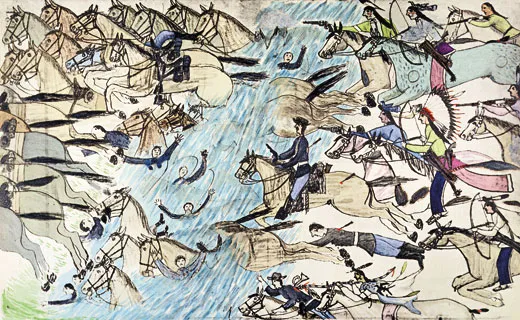
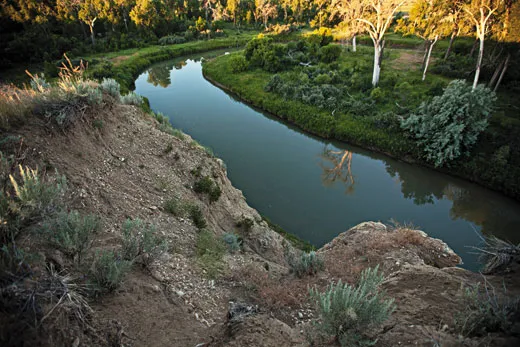
Two Moons said he saw soldiers "drib into the river-bed like buffalo fleeing." The Minneconjou warrior Cherry Horse said several troops drowned. Many of the Indians charged beyond the river later the soldiers and chased them every bit they raced up the bluffs toward a loma (at present known as Reno Hill, for the major who led the soldiers). White Eagle, the son of Oglala main Horned Horse, was killed in the hunt. A soldier stopped just long enough to scalp him—one quick circumvolve-cut with a abrupt knife, and then a yank on a fistful of hair to rip the skin loose.
The whites had the worst of it. More than 30 were killed earlier they reached the top of the hill and dismounted to brand a stand. Amid the bodies of men and horses left on the flat by the river below were ii wounded Ree scouts. The Oglala Red Hawk said afterwards that "the Indians [who institute the scouts] said these Indians wanted to die—that was what they were scouting with the soldiers for; so they killed them and scalped them."
The soldiers' crossing of the river brought a second animate spell in the fight. Some of the Indians chased them to the superlative of the colina, but many others, like Black Elk, lingered to pick up guns and ammunition, to pull the clothes off dead soldiers or to grab delinquent horses. Crazy Horse promptly turned back with his men toward the eye of the great military camp. The only Indian to offer an explanation of his precipitous withdrawal was Gall, who speculated that Crazy Horse and Crow King, a leading man of the Hunkpapa, feared a second assail on the military camp from some signal north. Gall said they had seen soldiers heading that way forth the bluffs on the opposite banking company.
The fight forth the river flat—from the outset sighting of soldiers riding toward the Hunkpapa camp until the last of them crossed the river and made their way to the top of the hill—had lasted most an hour. During that time, a second grouping of soldiers had shown itself at to the lowest degree three times on the eastern heights above the river. The first sighting came only a minute or two after the showtime group began to ride toward the Hunkpapa camp—about five minutes past iii. 10 minutes later, just before the first group formed a skirmish line, the second group was sighted across the river again, this time on the very hill where the first group would have shelter later on their mad retreat across the river. At about one-half-past iii, the second grouping was seen yet again on a high bespeak in a higher place the river not quite halfway between Reno Hill and the Cheyenne hamlet at the northern cease of the big camp. By then the kickoff group was retreating into the timber. It is likely that the second group of soldiers got their first articulate view of the long sprawl of the Indian military camp from this high bluff, later called Weir Point.
The Yanktonais White Thunder said he saw the 2d group make a move toward the river south of the ford by the Cheyenne camp, and so turn back on reaching "a steep cut bank which they could not become downwardly." While the soldiers retraced their steps, White Thunder and some of his friends went e upwards and over the high footing to the other side, where they were presently joined by many other Indians. In effect, White Thunder said, the second group of soldiers had been surrounded fifty-fifty before they began to fight.
From the spot where the first group of soldiers retreated across the river to the adjacent crossing place at the northern terminate of the big army camp was virtually iii miles—roughly a 20-infinitesimal ride. Between the two crossings steep bluffs blocked much of the river's eastern bank, simply simply beyond the Cheyenne camp was an open stretch of several hundred yards, which later was called Minneconjou Ford. It was here, Indians say, that the second group of soldiers came closest to the river and to the Indian camp. By nearly Indian accounts information technology wasn't very close.
Budgeted the ford at an angle from the high ground to the southeast was a dry creek bed in a shallow ravine now known as Medicine Tail Coulee. The exact sequence of events is difficult to institute, but it seems likely that the first sighting of soldiers at the upper finish of Medicine Tail Coulee occurred at about 4 o'clock, just every bit the first group of soldiers was making its dash up the bluffs toward Reno Hill and Crazy Horse and his followers were turning back. Two Moons was in the Cheyenne camp when he spotted soldiers coming over an intervening ridge and descending toward the river.
Gall and three other Indians were watching the same soldiers from a loftier betoken on the eastern side of the river. Well out in front were two soldiers. Ten years later, Gall identified them equally Custer and his orderly, but more probably it was not. This homo he called Custer was in no hurry, Gall said. Off to Gall's right, on i of the bluffs upriver, some Indians came into sight every bit Custer approached. Plume Earring, a Minneconjou, said Indians were but and then coming upwards from the south on that side of the river "in great numbers." When Custer saw them, Gall said, "his pace became slower and his actions more cautious, and finally he paused altogether to look the coming upwardly of his command. This was the nearest point any of Custer'southward party ever got to the river." At that point, Gall went on, Custer "began to suspect he was in a bad scrape. From that time on Custer acted on the defensive."
Others, including Iron Militarist and Feather Earring, confirmed that Custer and his men got no closer to the river than that—several hundred yards back up the coulee. Most of the soldiers were even so further dorsum upwards the hill. Some soldiers fired into the Indian camp, which was near deserted. The few Indians at Minneconjou Ford fired dorsum.
The earlier pattern repeated itself. Petty stood in the soldiers' way at first, but within moments more Indians began to arrive, and they kept coming—some crossing the river, others riding upwardly from the south on the east side of the river. Past the time 15 or 20 Indians had gathered nigh the ford, the soldiers had hesitated, then begun to ride upwardly out of Medicine Tail Coulee, heading toward high footing, where they were joined past the rest of Custer's command.
The battle known as the Custer Fight began when the small, leading disengagement of soldiers approaching the river retreated toward higher ground at about 4:xv. This was the last move the soldiers would take freely; from this moment on everything they did was in response to an Indian attack growing speedily in intensity.
Every bit described by Indian participants, the fighting followed the contour of the ground, and its pace was adamant by the fourth dimension information technology took for Indians to gather in force and the comparatively few minutes it took for each successive grouping of soldiers to be killed or driven back. The path of the boxing follows a sweeping arc up out of Medicine Tail Coulee across another swale into a depression known as Deep Coulee, which in turn opens upwards and out into a rising slope cresting at Calhoun Ridge, ascent to Calhoun Loma, and and so proceeds, still ascension, by a depression in the ground identified as the Keogh site to a second elevation known as Custer Loma. The high footing from Calhoun Loma to Custer Hill was what men on the plains called "a backbone." From the indicate where the soldiers recoiled abroad from the river to the lower end of Calhoun Ridge is about three-quarters of a mile—a hard, 20-minute uphill slog for a human on foot. Shave Elk, an Oglala in Crazy Horse's ring, who ran the altitude after his horse was shot at the start of the fight, remembered "how tired he became before he got up in that location." From the bottom of Calhoun Ridge to Calhoun Loma is another uphill climb of nigh a quarter-mile.
But it would exist a fault to presume that all of Custer'due south command—210 men—advanced in line from one signal to another, downwards one coulee, up the other canyon and then on. Just a pocket-size detachment had approached the river. Past the fourth dimension this grouping rejoined the rest, the soldiers occupied a line from Calhoun Loma forth the courage to Custer Loma, a distance of a footling over one-half a mile.
The uphill route from Medicine Tail Coulee over to Deep Coulee and upwards the ridge toward Custer Colina would accept been well-nigh a mile and a one-half or a footling more than. Red Horse would later on say that Custer's troops "fabricated five different stands." In each instance, combat began and ended in about 10 minutes. Recollect of information technology every bit a running fight, equally the survivors of each separate disharmonism fabricated their fashion along the backbone toward Custer at the stop; in event the control collapsed back in on itself. Equally described by the Indians, this phase of the battle began with the scattering of shots near Minneconjou Ford, unfolding then in brief, devastating clashes at Calhoun Ridge, Calhoun Loma and the Keogh site, climaxing in the killing of Custer and his entourage on Custer Hill and ending with the pursuit and killing of about xxx soldiers who raced on foot from Custer Hill toward the river down a deep ravine.
Dorsum at Reno Hill, just over four miles to the south, the soldiers preparing their defenses heard three episodes of heavy firing—1 at 4:25 in the afternoon, about ten minutes after Custer's soldiers turned back from their arroyo to Minneconjou Ford; a second well-nigh 30 minutes later on; and a final burst about 15 minutes later that, dying off before 5:15. Distances were great, simply the air was withal, and the .45/55 caliber round of the cavalry carbine fabricated a thunderous nail.
At v:25 some of Reno'south officers, who had ridden out with their men toward the shooting, glimpsed from Weir Bespeak a afar hillside swarming with mounted Indians who seemed to exist shooting at things on the ground. These Indians were not fighting; more likely they were finishing off the wounded, or just following the Indian custom of putting an actress bullet or arrow into an enemy's trunk in a gesture of triumph. Once the fighting began it never died away, the last scattering shots standing until night brutal.
The officers at Weir Betoken also saw a full general motion of Indians—more Indians than whatever of them had ever encountered earlier—heading their manner. Before long the forwards elements of Reno's control were exchanging fire with them, and the soldiers quickly returned to Reno Hill.
As Custer'due south soldiers made their way from the river toward college ground, the country on three sides was rapidly filling with Indians, in effect pushing as well as following the soldiers uphill. "We chased the soldiers up a long, gradual slope or hill in a management abroad from the river and over the ridge where the battle began in good hostage," said Shave Elk. By the time the soldiers made a stand up on "the ridge"—evidently the courage connecting Calhoun and Custer hills—the Indians had begun to fill the coulees to the south and due east. "The officers tried their utmost to keep the soldiers together at this point," said Red Hawk, "simply the horses were unmanageable; they would rear upwards and autumn backward with their riders; some would get away." Crow King said, "When they saw that they were surrounded they dismounted." This was cavalry tactics by the volume. There was no other style to brand a stand up or maintain a stout defense. A brief period followed of deliberate fighting on foot.
As Indians arrived they got off their horses, sought cover and began to converge on the soldiers. Taking advantage of brush and every little swale or rising in the ground to hide, the Indians made their style uphill "on hands and knees," said Red Plume. From one moment to the next, the Indians popped upwards to shoot before dropping back down again. No human being on either side could show himself without drawing burn. In battle the Indians often wore their feathers down apartment to aid in concealment. The soldiers appear to accept taken off their hats for the same reason; a number of Indians noted hatless soldiers, some dead and some still fighting.
From their position on Calhoun Hill the soldiers were making an orderly, concerted defence. When some Indians approached, a detachment of soldiers rose upwardly and charged downhill on pes, driving the Indians dorsum to the lower finish of Calhoun Ridge. Now the soldiers established a regulation skirmish line, each man virtually 5 yards from the adjacent, kneeling in order to take "deliberate aim," co-ordinate to Yellow Nose, a Cheyenne warrior. Some Indians noted a 2nd skirmish line as well, stretching perhaps 100 yards away along the backbone toward Custer Hill. It was in the fighting around Calhoun Hill, many Indians reported subsequently, that the Indians suffered the most fatalities—11 in all.
Only almost equally soon as the skirmish line was thrown out from Calhoun Colina, some Indians pressed in once again, snaking upward to shooting distance of the men on Calhoun Ridge; others fabricated their manner around to the eastern slope of the hill, where they opened a heavy, mortiferous fire on soldiers holding the horses. Without horses, Custer'due south troops could neither charge nor flee. Loss of the horses also meant loss of the saddlebags with the reserve ammunition, nigh 50 rounds per man. "Equally soon as the soldiers on foot had marched over the ridge," the Yanktonais Daniel White Thunder subsequently told a white missionary, he and the Indians with him "stampeded the horses...by waving their blankets and making a terrible dissonance."
"We killed all the men who were property the horses," Gall said. When a horse holder was shot, the frightened horses would lunge about. "They tried to hold on to their horses," said Crow Rex, "merely as we pressed closer, they permit go their horses." Many charged downwardly the hill toward the river, adding to the confusion of battle. Some of the Indians quit fighting to hunt them.
The fighting was intense, bloody, at times hand to mitt. Men died by pocketknife and society as well as by gunfire. The Cheyenne Brave Carry saw an officeholder riding a sorrel horse shoot two Indians with his revolver before he was killed himself. Brave Carry managed to seize the horse. At well-nigh the same moment, Yellowish Nose wrenched a cavalry guidon from a soldier who had been using it as a weapon. Eagle Elk, in the thick of the fighting at Calhoun Hill, saw many men killed or horribly wounded; an Indian was "shot through the jaw and was all bloody."
Calhoun Hill was swarming with men, Indian and white. "At this place the soldiers stood in line and made a very good fight," said Red Hawk. Merely the soldiers were completely exposed. Many of the men in the skirmish line died where they knelt; when their line collapsed back up the colina, the entire position was rapidly lost. It was at this moment that the Indians won the battle.
In the minutes before, the soldiers had held a single, roughly continuous line along the one-half-mile backbone from Calhoun Hill to Custer Colina. Men had been killed and wounded, only the force had remained largely intact. The Indians heavily outnumbered the whites, simply cypher similar a rout had begun. What changed everything, according to the Indians, was a sudden and unexpected charge up over the backbone by a large forcefulness of Indians on horseback. The fundamental and controlling part Crazy Horse played in this set on was witnessed and later reported by many of his friends and relatives, including He Domestic dog, Red Feather and Flying Hawk.
Recall that as Reno's men were retreating across the river and up the bluffs on the far side, Crazy Horse had headed back toward the center of camp. He had time to reach the mouth of Muskrat Creek and Medicine Tail Coulee by iv:xv, just as the small detachment of soldiers observed by Gall had turned back from the river toward college ground. Flight Hawk said he had followed Crazy Horse downward the river past the center of campsite. "Nosotros came to a ravine," Flight Hawk later recalled, "then we followed up the gulch to a place in the rear of the soldiers that were making the stand on the colina." From his half-protected vantage at the head of the ravine, Flying Militarist said, Crazy Equus caballus "shot them as fast equally he could load his gun."
This was i style of Sioux fighting. Another was the dauntless run. Typically the change from one to the other was preceded by no long discussion; a warrior simply perceived that the moment was right. He might shout: "I am going!" Or he might yell "Hokahey!" or give the state of war trill or clench an hawkeye bone whistle between his teeth and blow the piercing scree audio. Red Feather said Crazy Horse'south moment came when the two sides were keeping low and popping up to shoot at each other—a standoff moment.
"There was a bully bargain of noise and confusion," said Waterman, an Arapaho warrior. "The air was heavy with pulverisation fume, and the Indians were all yelling." Out of this chaos, said Red Feather, Crazy Equus caballus "came upwards on horseback" blowing his eagle bone whistle and riding betwixt the length of the 2 lines of fighters. "Crazy Horse...was the bravest human I ever saw," said Waterman. "He rode closest to the soldiers, yelling to his warriors. All the soldiers were shooting at him but he was never striking."
After firing their rifles at Crazy Horse, the soldiers had to reload. It was then that the Indians rose upward and charged. Among the soldiers, panic ensued; those gathered effectually Calhoun Hill were of a sudden cut off from those stretching along the backbone toward Custer Hill, leaving each bunch vulnerable to the Indians charging them on human foot and horseback.
The soldiers' way of fighting was to try to keep an enemy at bay, to kill him from a distance. The instinct of Sioux fighters was the opposite—to charge in and engage the enemy with a quirt, bow or naked hand. There is no terror in boxing to equal physical contact—shouting, hot jiff, the grip of a manus from a man shut plenty to odor. The charge of Crazy Horse brought the Indians in among the soldiers, whom they clubbed and stabbed to expiry.
Those soldiers still alive at the southern end of the backbone at present made a run for information technology, grabbing horses if they could, running if they couldn't. "All were going toward the high ground at stop of ridge," the Brulé Foolish Elk said.
The skirmish lines were gone. Men crowded in on each other for safety. Atomic number 26 Hawk said the Indians followed close backside the fleeing soldiers. "By this time the Indians were taking the guns and cartridges of the dead soldiers and putting these to use," said Red Militarist. The boom of the Springfield carbines was coming from Indian and white fighters alike. But the killing was mostly i-sided.
In the blitz of the Calhoun Hill survivors to rejoin the remainder of the control, the soldiers savage in no more pattern than scattered corn. In the depression in which the body of Capt. Myles Keogh was found lay the bodies of some xx men crowded tight around him. But the Indians describe no real fight in that location, merely a rush without letup along the backbone, killing all the way; the line of bodies connected along the backbone. "We circled all round them," Two Moons said, "swirling like water circular a stone."
Another group of the dead, ten or more, was left on the slope rising up to Custer Colina. Between this group and the colina, a distance of about 200 yards, no bodies were found. The mounted soldiers had dashed alee, leaving the men on foot to fend for themselves. Maybe the ten who died on the slope were all that remained of the foot soldiers; perhaps no bodies were plant on that stretch of ground considering organized firing from Custer Hill held the Indians at bay while soldiers ran upward the gradient. Whatever the crusade, Indian accounts mostly concur that there was a suspension in the fighting—a moment of positioning, closing in, creeping up.
The interruption was brief; it offered no time for the soldiers to count survivors. By at present, half of Custer'southward men were expressionless, Indians were pressing in from all sides, the horses were wounded, expressionless or had run off. There was nowhere to hide. "When the horses got to the superlative of the ridge the gray ones and bays became mingled, and the soldiers with them were all in confusion," said Foolish Elk. Then he added what no white soldier lived to tell: "The Indians were so numerous that the soldiers could not go any further, and they knew that they had to die."
The Indians surrounding the soldiers on Custer Colina were now joined by others from every section of the field, from downriver where they had been chasing horses, from forth the ridge where they had stripped the dead of guns and ammunition, from upriver, where Reno's men could hear the get-go of the last heavy volley a few minutes past 5. "There were great numbers of us," said Eagle Bear, an Oglala, "some on horseback, others on human foot. Dorsum and forth in front of Custer we passed, firing all of the time."
Kill Eagle, a Blackfeet Sioux, said the firing came in waves. His interviewer noted that he clapped "the palms of his hands together very fast for several minutes" to demonstrate the intensity of the firing at its height, and so clapped slower, then faster, then slower, and then stopped.
In the fight's final stage, the soldiers killed or wounded very few Indians. As Brave Bear subsequently recalled: "I think Custer saw he was caught in [a] bad place and would like to have gotten out of it if he could, but he was hemmed in all effectually and could do nothing only to die and then."
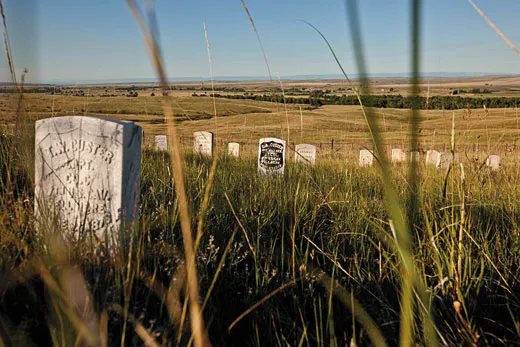
Exactly when custer died is unknown; his body was found in a pile of soldiers about the summit of Custer Hill surrounded past others within a circle of expressionless horses. It is likely he fell during the Indians' second, brief and terminal accuse. Before it began, Low Domestic dog, an Oglala, had called to his followers: "This is a adept twenty-four hour period to die: follow me." The Indians raced up together, a solid mass, close enough to whip each other'southward horses with their quirts then no human being would linger. "Then every chief rushed his horse on the white soldiers, and all our warriors did the same," said Crow King.
In their terror some soldiers threw downwardly their guns, put their hands in the air and begged to be taken prisoner. But the Sioux took merely women every bit prisoners. Red Horse said they "did not have a unmarried soldier, but killed all of them."
The last xl or more of the soldiers on foot, with only a few on horseback, dashed downhill toward the river. Ane of the mounted men wore buckskins; Indians said he fought with a large knife. "His men were all covered with white dust," said Two Moons.
These soldiers were met past Indians coming upwards from the river, including Black Elk. He noted that the soldiers were moving oddly. "They were making their arms get as though they were running, but they were merely walking." They were probable wounded—hobbling, lurching, throwing themselves frontwards in the hope of escape.
The Indians hunted them all down. The Oglala Brings Enough and Iron Hawk killed two soldiers running up a creek bed and figured they were the concluding white men to dice. Others said the final man dashed away on a fast horse upriver toward Reno Hill, and and so inexplicably shot himself in the caput with his own revolver. Still some other final man, it was reported, was killed past the sons of the noted Santee warrior chief Red Top. Two Moons said no, the final human being live had braids on his shirt (i.e., a sergeant) and rode one of the remaining horses in the final blitz for the river. He eluded his pursuers by rounding a hill and making his way back upriver. Only just as 2 Moons idea this man might escape, a Sioux shot and killed him. Of course none of these "terminal men" was the last to dice. That distinction went to an unknown soldier lying wounded on the field.
Presently the hill was swarming with Indians—warriors putting a final bullet into enemies, and women and boys who had climbed the long slopes from the village. They joined the warriors who had dismounted to empty the pockets of the expressionless soldiers and strip them of their wearing apparel. Information technology was a scene of horror. Many of the bodies were mutilated, merely in later years Indians did not like to talk about that. Some said they had seen it but did not know who had washed it.
But soldiers going over the field in the days following the boxing recorded detailed descriptions of the mutilations, and drawings made by Red Horse leave no room for doubt that they took place. Red Horse provided one of the earliest Indian accounts of the battle and, a few years later, made an boggling series of more than 40 large drawings of the fighting and of the dead on the field. Many pages were devoted to fallen Indians, each lying in his distinctive wearing apparel and headgear. Additional pages showed the dead soldiers, some naked, some half-stripped. Each page depicting the white expressionless showed severed artillery, hands, legs, heads. These mutilations reflected the Indians' belief that an private was condemned to have the body he brought with him to the afterlife.
Acts of revenge were integral to the Indians' notion of justice, and they had long memories. The Cheyenne White Necklace, so in her heart 50s and married woman of Wolf Chief, had carried in her heart bitter memories of the expiry of a niece killed in a massacre whites committed at Sand Creek in 1864. "When they found her there, her head was cut off," she said afterward. Coming up the hill just after the fighting had ended, White Necklace came upon the naked body of a expressionless soldier. She had a hand ax in her belt. "I jumped off my horse and did the same to him," she recalled.
Near Indians claimed that no ane really knew who the leader of the soldiers was until long after the boxing. Others said no, there was talk of Custer the very get-go mean solar day. The Oglala Piddling Killer, 24 years old at the time, remembered that warriors sang Custer'south name during the dancing in the large camp that night. Nobody knew which body was Custer's, Picayune Killer said, only they knew he was there. Threescore years later, in 1937, he remembered a song:
Long Hair, Long Pilus,
I was short of guns,
and you brought us many.
Long Hair, Long Hair,
I was short of horses,
and you brought the states many.
Every bit late as the 1920s, elderly Cheyennes said that ii southern Cheyenne women had come upon the body of Custer. He had been shot in the caput and in the side. They recognized Custer from the Boxing of the Washita in 1868, and had seen him up shut the post-obit bound when he had come to make peace with Stone Forehead and smoked with the chiefs in the lodge of the Pointer Keeper. At that place Custer had promised never once again to fight the Cheyennes, and Rock Forehead, to hold him to his promise, had emptied the ashes from the pipe onto Custer's boots while the general, all unknowing, sat directly beneath the Sacred Arrows that pledged him to tell the truth.
It was said that these 2 women were relatives of Mo-nah-se-tah, a Cheyenne daughter whose father Custer's men had killed at the Washita. Many believed that Mo-nah-se-tah had been Custer's lover for a fourth dimension. No matter how cursory, this would have been considered a marriage according to Indian custom. On the hill at the Little Bighorn, it was told, the 2 southern Cheyenne women stopped some Sioux men who were going to cut upward Custer's body. "He is a relative of ours," they said. The Sioux men went away.
Every Cheyenne woman routinely carried a sewing awl in a leather sheath decorated with chaplet or porcupine quills. The awl was used daily, for sewing clothing or gild covers, and mayhap most ofttimes for keeping moccasins in repair. Now the southern Cheyenne women took their awls and pushed them deep into the ears of the human being they believed to be Custer. He had not listened to Stone Forehead, they said. He had cleaved his promise not to fight the Cheyenne anymore. Now, they said, his hearing would be improved.
Thomas Powers is the author of eight previous books. Aaron Huey has spent 6 years documenting life among the Oglala Sioux on the Pine Ridge Reservation in South Dakota.
Adapted from The Killing of Crazy Horse, by Thomas Powers. Copyright © 2010. With the permission of the publisher, Alfred A. Knopf.
Source: https://www.smithsonianmag.com/history/how-the-battle-of-little-bighorn-was-won-63880188/
0 Response to "When You Kick Against the World You Kick Agains a Shappend Awl"
Post a Comment